

Ransomware Data Recovery
We professionally analyze files that have been encrypted or made inaccessible due to a ransomware attack. In ransomware, crypto malware, and CryptoLocker cases, we evaluate available decryption and data recovery options to provide secure and effective recovery solutions.
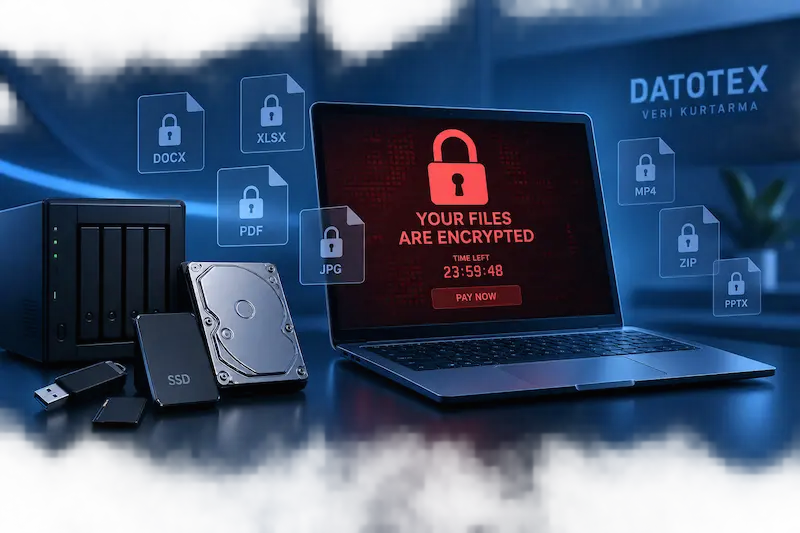
Have your files been encrypted by a ransomware attack?
Ransomware data recovery is the professional process of analyzing encrypted or inaccessible files on computers, servers, NAS systems and external drives and determining the safest available recovery method.
Datotex analyzes the ransomware family and encryption method, then evaluates available decryptors, decryption options, backups, snapshots, file-system remnants and alternative data recovery methods.
Our Antalya-based data recovery laboratory provides technical assessment for both individual and business ransomware cases.
Do not make random changes to encrypted files.
Incorrect actions may reduce the available recovery options. If you discover a ransomware attack:
- Disconnect affected devices from the network.
- Do not delete or rename encrypted files.
- Do not format the drive or reinstall the operating system.
- Keep the ransom note and encrypted file extensions.
- Do not overwrite or modify existing backups.
When may ransomware data recovery be possible?
Every ransomware incident is different. The ransomware family, encryption method and condition of the affected system must be assessed before recovery options can be determined.
Files have been encrypted
Word, Excel, PDF, photo, video, project and business files may have received an unknown extension or become inaccessible after the attack.
Decryptor research
Once the ransomware family is identified, known decryption methods, available decryptors and possible key-based recovery options are evaluated.
Server and NAS attacks
Encrypted business data on Windows Server, NAS, RAID and network storage systems can be technically assessed for recovery options.
Alternative data recovery
If direct decryption is not possible, backups, snapshots, deleted files and file-system remnants may provide alternative recovery paths.
How does ransomware data recovery work?
Before any recovery attempt, the ransomware type and available recovery options are assessed.
Ransomware Identification
The ransom note, encrypted file extensions and sample files are examined to identify the ransomware family or variant where possible.
Technical Assessment
Decryption possibilities, available decryptors, storage structure, backups, snapshots and alternative recovery paths are evaluated.
Data Recovery
The most appropriate method is selected and decryption or data recovery is performed while minimizing unnecessary changes to the source data.
Verification & Delivery
Recovered files are checked for accessibility and integrity before the result and delivery options are presented to the customer.
Ransomware data recovery and decryption
Can files encrypted by ransomware be recovered?
In some cases, yes. Recoverability depends on the ransomware family, encryption method, availability of decryption keys or decryptors, backups, snapshots and the condition of the affected storage system. A technical assessment is required before the chances of recovery can be determined.
Can every ransomware infection be decrypted?
No. Some ransomware families have known decryption tools or released keys, while others use strong encryption that cannot be directly decrypted without the correct key.
Can CryptoLocker-encrypted files be recovered?
CryptoLocker and similar ransomware cases must first be identified by family and variant. Available decryptors, keys, backups and alternative recovery methods are then evaluated.
What should I do after a ransomware attack?
Disconnect affected devices from the network, do not delete encrypted files, do not format the storage device and do not overwrite existing backups. Preserve the ransom note and sample encrypted files for technical assessment.
How much does ransomware data recovery cost?
Pricing depends on the amount of affected data, system configuration, ransomware family, decryption method and any additional data recovery work required. A more accurate price can be provided after the initial technical assessment.
If your files have been encrypted by ransomware, have the system assessed before attempting recovery.
Contact Datotex for a technical assessment to identify the ransomware and determine the available decryption and data recovery options.